Lapis Lazuli bracelet
Not a mineral. A rock, with gold flecks that are iron pyrite.
Pick this one before you have to say the difficult thing.
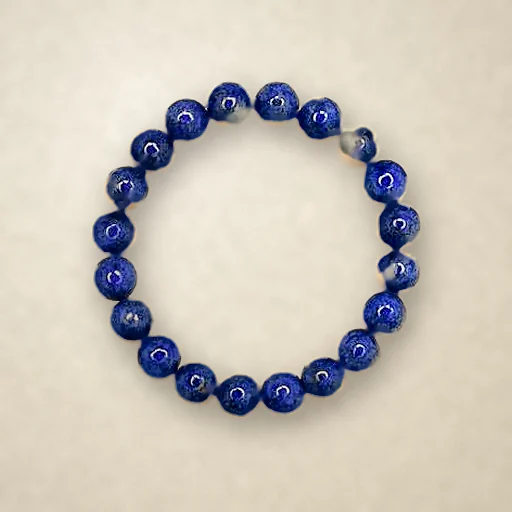
- 8mm round beads on elastic, about 7–7.5 inches: fits most adult wrists
- Laboratory certificate naming the material, in the box
- Any dyeing or heat treatment stated on the invoice
- Free delivery over ₹1,599 · dispatched in three to five working days
Seven-day returns. Unworn and in the original packing, back within seven days of delivery, full refund including what you paid for delivery. If it arrives damaged, send a photograph on WhatsApp within 48 hours and we replace it. We don’t publish a warranty beyond that, because the elastic on a bead bracelet is a wearing part and we are not going to promise something we would argue about later.
Want your wrist measurement strung to size, or a photograph of the actual piece before it is packed? Ask on WhatsApp.
Who picks this one
Pick this one if there is something you have to say out loud: a viva, a presentation, a conversation you have been putting off for a month. It is the most striking bracelet here, deep blue with gold pyrite, and it is the one people will notice and ask about. It is also the softest thing we sell, so it is the wrong choice if you want something to wear while doing anything physical.
What it actually is
Lapis lazuli is a rock rather than a single mineral: mostly lazurite, with white calcite and the brassy specks of pyrite that people take for gold. Those three components are how you grade it, deep even blue with a scattering of pyrite and little calcite is the good material. The historic source is Badakhshan in north-eastern Afghanistan, mined for thousands of years, and ultramarine pigment was made by grinding it long before anyone synthesised the colour. At Mohs 5–5.5 it is the softest stone we keep, and it is frequently dyed and wax-treated in the trade.
Where it sits in the tradition
Lapis appears in the common uparatna lists for neelam, the stone of Shani, alongside amethyst, iolite and blue zircon.
Which stone applies to you, if any does, comes from a chart rather than from a page. A reader can look, and this is what ratna and uparatna mean.
What we will not tell you
That it will fix your money, your marriage, your case or your health. Nobody can know that, and in India advertising a remedy as a treatment is prohibited under the Drugs and Magic Remedies (Objectionable Advertisements) Act, 1954. What we will tell you is exactly what the material is, what has been done to it, and what is in the box.
Looking after it
The one on this page that needs actual care. Soft, and porous enough that water, soap and perfume will dull it. Dry cloth only, and take it off before washing your hands.
Bought together with
Not a guess and not somebody else’s basket: these are the stones we actually pack alongside this one, and the set each pairing comes from.
- The Study Set ₹2,199 Packed with Clear Quartz, Tiger Eye, for exams and interviews.
About this stone.
Are the gold flecks real gold?
No. They are pyrite, an iron sulphide. Their presence is a sign of natural lapis rather than a reconstituted or dyed imitation.
Is lapis often dyed?
Yes, dyeing and waxing are common in this trade. Where a stone we sell has been treated we state it on the listing and on the invoice.