Amethyst bracelet
Heat it and it turns into citrine. Most citrine on the market is this stone.
Pick this one for the end of the day, not the start.
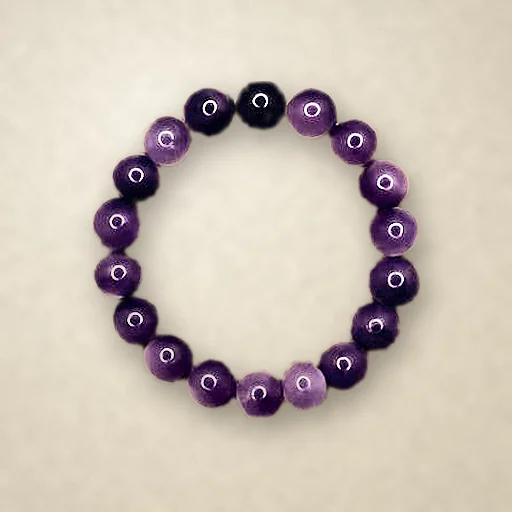
- 8mm round beads on elastic, about 7–7.5 inches: fits most adult wrists
- Laboratory certificate naming the material, in the box
- Any dyeing or heat treatment stated on the invoice
- Free delivery over ₹1,599 · dispatched in three to five working days
Seven-day returns. Unworn and in the original packing, back within seven days of delivery, full refund including what you paid for delivery. If it arrives damaged, send a photograph on WhatsApp within 48 hours and we replace it. We don’t publish a warranty beyond that, because the elastic on a bead bracelet is a wearing part and we are not going to promise something we would argue about later.
Want your wrist measurement strung to size, or a photograph of the actual piece before it is packed? Ask on WhatsApp.
Who picks this one
Pick this one if the season you are in is a thin-sleep one and you want something for the evening rather than for the office. It is the deepest colour we keep and the one that most reads as a stone rather than a bead. Keep it out of the sun between wearings: the purple fades in prolonged direct light, which is a property of the material and not a fault in the strand.
What it actually is
Amethyst is quartz coloured purple by traces of iron that have been altered by natural irradiation in the ground. Heat undoes it: warm amethyst to a few hundred degrees and the purple turns yellow-orange. That is not a curiosity, it is where most commercial citrine comes from, which is why we are careful about the word. Amethyst also fades in prolonged direct sunlight for the same reason it exists. Mohs 7. Brazil, Uruguay and Zambia are the usual sources.
Where it sits in the tradition
Amethyst is katela in Hindi, and it is the most commonly named uparatna for neelam (blue sapphire), the stone of Shani. Neelam is also the stone practitioners are most cautious about prescribing, and traditionally the one given on trial before it is worn permanently. We will not prescribe either over a chat window.
Which stone applies to you, if any does, comes from a chart rather than from a page. A reader can look, and this is what ratna and uparatna mean.
What we will not tell you
That it will fix your money, your marriage, your case or your health. Nobody can know that, and in India advertising a remedy as a treatment is prohibited under the Drugs and Magic Remedies (Objectionable Advertisements) Act, 1954. What we will tell you is exactly what the material is, what has been done to it, and what is in the box.
Looking after it
Keep it out of prolonged direct sun, which fades the purple. Dry cloth, no perfume.
Bought together with
Not a guess and not somebody else’s basket: these are the stones we actually pack alongside this one, and the set each pairing comes from.
- The Quiet Set ₹2,199 Packed with Blue Chalcedony, Rainbow Moonstone, for rest and steadiness.
About this stone.
Is my citrine really heated amethyst?
Most commercial citrine is. It is a normal and disclosed treatment across the trade, not a fake, but it should be disclosed, and we disclose treatment on the listing and on the invoice.
Is amethyst a substitute for neelam?
It is the most commonly named one. That does not mean neelam is indicated for you; a reader decides that from a chart, and we do not sell neelam.